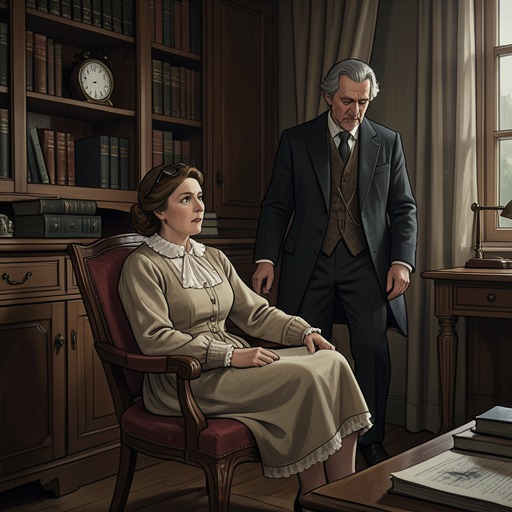
Henry reunites with Clare in her old age
The Time Traveler's WifeHenry reunites with Clare in her old age on July 24, 2053, when a time-displaced Henry appears in the room where 82-year-old Clare is waiting. Their recognition and embrace fulfill a future Henry had previously encountered and told Clare about, giving the novel’s recurring separations a final, intimate return. The scene’s force lies not in undoing absence but in showing that Clare has endured it with the knowledge that this meeting will come.
A Reunion Foreseen
Henry has already told Clare that, during a visit to Dr. Kendrick’s waiting room, he suddenly found himself in an unfamiliar house. From a dark hallway cluttered with galoshes, he saw an older woman in a coral-colored sweater, seated by a window with a cup of tea. When she turned, he recognized the woman as Clare in old age. He described the encounter as a return from death and told her that they would see each other again. The later reunion thus arrives first as a promise carried into the future by Henry’s account of an involuntary journey through time.
That foreknowledge does not make the meeting ordinary or remove its uncertainty. Henry had kept the encounter from Clare until late in his life, and his account gave her an assurance without giving her control over when it would be fulfilled. The eventual scene returns to the same details that made the earlier vision recognizable: the hallway, the light around the door, the old woman, the coral sweater, and the tea beside her. What had been a future glimpse becomes a present meeting.
The Meeting in 2053
The reunion is dated July 24, 2053, and told by Henry. He finds himself in a dark hallway filled with galoshes and raincoats. A partly open door lets white light spill into the hall. Beyond it, morning fills a room arranged around a plain wooden table and a window overlooking the lake. A teacup rests beside the woman seated there. These are not incidental surroundings: they repeat the setting Henry had described to Clare, allowing him—and the reader—to recognize the scene as the fulfillment of his earlier visit.
At first Henry knows the woman only through the familiar details of her posture, white hair, and coral-colored sweater. When the floor creaks and she turns, recognition changes the encounter: Henry sees that the woman is Clare, and her face brightens with joy. She comes to him slowly, and he takes her into his arms. The scene gives their reunion its decisive action through recognition and touch rather than explanation; the long-awaited promise becomes concrete when the two meet in the same room.
Clare’s Waiting
The narrative also records Clare’s morning on July 14, 2053, ten days before Henry’s arrival. At 82, she gets up at dawn, dresses, brushes her hair, makes toast and tea, and sits looking toward the lake. Her routine resembles earlier periods when Henry was gone and she waited for him to return. The difference is that this time she has instructions and knows that Henry will come eventually. That certainty sustains her expectation, though she wonders whether being ready for him somehow prevents the meeting from happening.
Clare’s account makes the reunion more than a sudden arrival. It is the destination of a life organized around both ordinary days and repeated absences: she continues to rise, prepare breakfast, and watch the water, while carrying knowledge of a return whose timing remains beyond her control. Her waiting is not presented as an end in itself. The reunion answers it, but only after the years in which she has had to live without knowing which day will bring Henry back.
Time, Recognition, and Return
The episode gathers the novel’s divided chronology into one meeting. The reader first receives the old-age reunion as Henry’s earlier vision, then encounters Clare’s later account of waiting in 2053, and finally sees Henry arrive on July 24. These differently dated passages make the same future legible from more than one position: Henry has seen it before Clare experiences it, while Clare waits with an assurance obtained from him. The reader must hold those moments together rather than assume that narrative order and lived chronology coincide.
The repeated objects and gestures bind those temporal positions together. The galoshes and raincoats, the bright room, the lake-facing window, the teacup, and the coral sweater recur between Henry’s earlier description and his eventual arrival. The repetition offers recognition across time, but it does not collapse the years between the two accounts. Clare has aged to 82; Henry appears through time displacement. Their embrace completes the promised return while leaving intact the condition that shaped their life together: Henry’s arrivals are not governed by ordinary chronology, and Clare cannot make him come simply by waiting.